



There are two examples of American justice that never fail to warm my heart. The first is how O.J. Simpson walked free after a little light murder. The second is how Hims & Hers will undoubtedly walk free after theirs - though in fairness to the Juice, at least he didn't claim to be democratizing justice while brandishing the knife.
Hims & Hers is the apex predator of the insecure millennial. If you look at their branding - the serif fonts, the muted "millennial beige" color palette, the cactus-green bottles - it’s all designed to bypass the part of your brain that associates medicine with *sickness*. In the old days (and by old days, I mean, like, 1998), if you had erectile dysfunction or male pattern baldness, you had to undergo the humiliating ritual of the In-Person Appointment. You had to sit on the crinkly paper. You had to make eye contact with a guy named Dr. Lipshitz and admit that your body was failing you. It was awful, but there was a kind of moral friction to it. It was *real*.
But today, Hims removes that friction, and turns the patient into a "member" and the treatment into a "lifestyle hack." To see what I mean - just take a look at the company's Super Bowl commercial in early 2025 - titled "Sick of the System". Between the beer ads and the crypto pitches, Hims positioned itself as David against Big Pharma's Goliath, dramatically blaming "Big Pharma's price-gouging" for making effective weight-loss drugs unaffordable while promoting their own cheaper compounded semaglutide. Within weeks, this self-appointed enemy of pharmaceutical greed would partner with Novo Nordisk, the very Danish giant behind the thousand-dollar-a-month Wegovy injections they had just finished condemning.
Their partnership lasted exactly two months. Which, in fairness to both parties, is longer than most celebrity marriages and roughly equivalent to the lifespan of a mayfly (though considerably less dignified than either).
What happened in those eight weeks reveals something essential about the kind of company Hims has become.
It turns out that while Hims was shaking hands in the boardroom, they were simultaneously selling what Novo described as “illegitimate, knockoff versions” of Novo’s own flagship drug out the back door. And when Novo pointed this out - noting that the mass-compounding was supposed to stop - Hims essentially shrugged - pffft - and so the deal collapsed.
"We had an agreement that the mass compounding would stop and unfortunately it didn't," a Novo VP explained at the time. "That's why we ended the partnership."

This, my friends, is a perfect crystallization of Hims’ style of corporate duplicity: promising a Healthcare Revolution while profiting from the very system they claimed to oppose.
In Which We Learn That Adding Vitamin B12 to Anything Makes It "Personalized Medicine"
To understand the money at play here - which is why Hims is so motivated to keep screwing customers over - you have to understand the “Compounding Exemption.”
You see: in a sane world, compounding is for edge cases. A patient allergic to the dye! A child who needs a liquid version of a solid pill! The FDA allows pharmacists to mix these custom batches. It is a compassionate loophole.
But Hims takes the concept of personalized compounding and abuses it at industrial scale.
For example - by adding a token amount of Vitamin B12 to semaglutide, Hims can call it a “compounded” drug that is legally a unique, personalized prescription, - but functionally acts a a way to mass-produce a patent-protected drug without a single glance from the FDA.
And they are hardly alone in this exploitation of regulatory good faith. Companies like Eden are marketing sermorelin - another peptide hormone - as fitness enhancers with bold taglines like "Cardio + Strength" and promises that the compound "may support HGH production." Never mind that sermorelin's original FDA approval was withdrawn because the manufacturer simply stopped selling it in 2008...

The Ketchup-and-Mustard School of Erectile Dysfunction Treatment
Perhaps a more telling aspect of the Hims empire lies in their approach to sexual dysfunction - specifically, their "Hard Mints," chewable tablets combining both sildenafil and tadalafil (the active ingredients in Viagra and Cialis). To me, this is basically the pharmaceutical equivalent of putting both ketchup and mustard on a hot dog and calling it “gourmet”. You can’t just slap these together to make a better acting drug!
What makes this particularly grotesque is its resemblance to the infamous "Rhino" pills that haunted gas station counters in the early 2000s. Those black-market supplements secretly contained both sildenafil and tadalafil - and poor guys not knowing any better took these and ended up in emergency rooms. The agency repeatedly flagged products like "Rhino SE7EN" for containing undisclosed pharmaceutical ingredients, noting the dangers especially for men on nitrates or with heart conditions.
Hims has essentially taken this discredited gas-station formula, added a dash of vitamin B12 for "personalization," and called it a day. It’s a remarkably shoddy job at making themselves look legitimate, frankly.

The company's own blog warns against combining Viagra and Cialis due to risks including "sudden drops in blood pressure," even as they market products that do exactly that.
To me, this contradiction - simultaneously cautioning against and profiting from the same practice - would be remarkable… if it were not otherwise so characteristic of the entire enterprise.
How to Extract $3,588 from Someone Who Just Wants Help
The genius of Hims lies in understanding that consumers will pay almost any premium to avoid the humiliation of discussing erectile dysfunction or hair loss with an actual human being. They have identified a market inefficiency in desperation, and built an empire around it. Their telehealth consultations are brief by design, their prescriptions are near-automatic, because the human interaction between “I want Viagra!” and “My Viagra arrived in the mail! Yipee!” has been minimized.
This becomes even clearer when examining their pricing structure. The drugs Hims prescribes are, in most cases, generic medications that have been available for decades. Sildenafil (the active ingredient in Viagra) costs roughly $2-4 per pill through traditional pharmacies like Amazon Pharmacy or GoodRx - sometimes even less with insurance. Finasteride for hair loss runs about $10-15 per month as a generic, and can cost as little as $2 per month with a GoodRx coupon.
Yet Hims is getting away with charging $79 per month for "personalized kits" of these same drugs, all the while locking customers into ten-month advance payments. Their own website admits that finasteride "usually costs between $20 and $60" depending on where you buy(!) then pegs their own price at $22 per month - dramatically more expensive than alternatives.
But who's counting when you're disrupting the healthcare-industrial complex one follicle at a time?

It doesn’t take a long time trawling through various subreddits to discover a myriad of customer complaints about Hims - like people being charged $300-400 immediately after brief online questionnaires, or getting prescriptions "approved in 1 minute" with no live doctor interaction - which is either remarkably efficient healthcare or remarkably efficient fraud, depending on your perspective. One Reddit user recounts here: "Didn't talk to a single doctor and was charged $395!!! … Approved in 1 min by checking some boxes and then charged within 5 min." And another spent $3,588 on a weight-loss subscription only to discover the drugs made them violently ill. When they sought a refund, they learned what many customers learn too late: that convenience and customer service are not the same thing.
But the subscription traps are where the real Extraction occurs. Customers complain of being locked into year-long commitments they can't escape, like hotel California but with erectile dysfunction pills. Better Business Bureau complaints reveal complaints by customers who try to pause subscriptions for six months only to have Hims automatically resume billing without warning, charging $85 "out of the blue." Others discovered they had been auto-enrolled in recurring shipments without notification.
When they try to cancel immediately - because apparently "immediately" is a foreign concept in Subscriptionland - Hims refuses refunds because the product has already shipped.
(Ironically, Amazon itself offers many of these same medications at a fraction of the cost, with actual pharmacists available for consultation and no year-long subscription traps - but Amazon doesn't market shame as a premium service)
A Brief Digression on the Commodification of Side Effects
Hims also sells "oral weight loss kits" with no GLP-1 in them, but these might be even worse in a way. What makes them particularly grotesque is their shotgun approach to pharmacology: rather than prescribing one medication and monitoring its effects, Hims is combining three or four different drugs into cocktails that have never been tested together - what they call "personalized kits" that can "include a combination of bupropion, metformin, topiramate, vitamin B12, and naltrexone," taken once or twice daily.
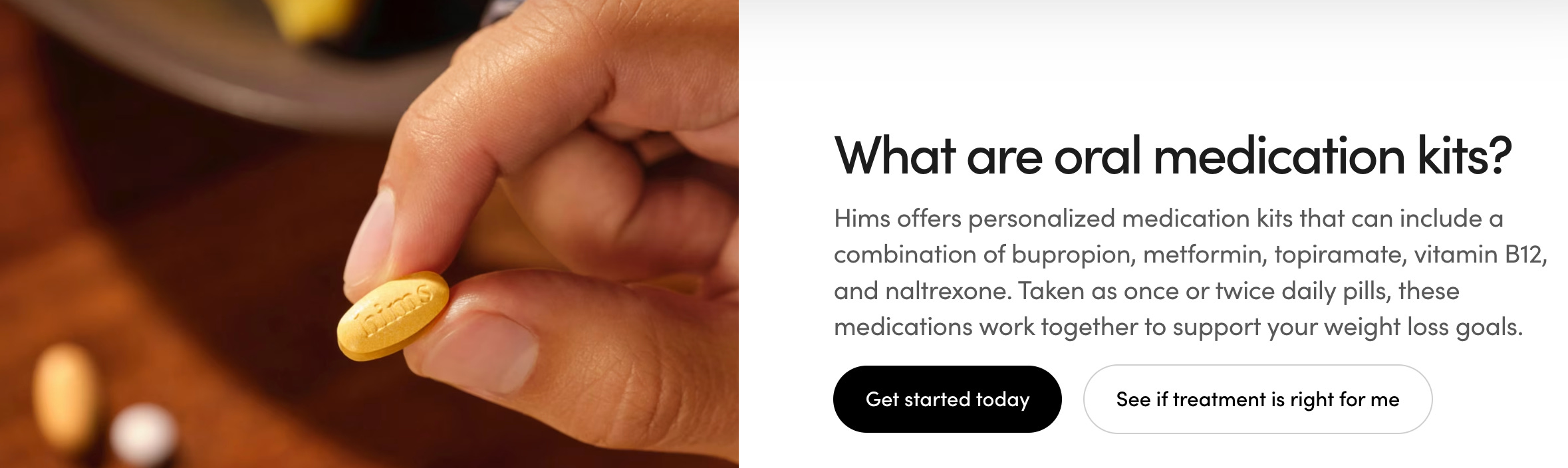
While each medication is sometimes used individually for weight management, or in known FDA-approved pairings like bupropion plus naltrexone (Contrave), Hims literally just puts them all into a horse pill. One user described being prescribed a triple regimen: bupropion XL every morning, plus a naltrexone + B12 tablet each morning, with metformin to be added later. The patient experienced severe side effects within hours: "massive headaches" followed by repeated vomiting for hours. They were so sick they had to stop and consult the provider, who then advised re-introducing the drugs one by one more gradually.
(BTW: while a single generic pill might cost a few dollars, a "personalized kit" of multiple medications can command $79 per month, paid ten months in advance)
How to Source Your Pharmaceuticals Like a Wish.com Order
The paper trail behind Hims' $165-per-month weight-loss shots reveals a supply chain designed around regulatory arbitrage, and a troubling one at that. A broader analysis of 2,465 GLP-1 shipments by the Partnership for Safe Medicines found that nearly 10 percent came from unregistered factories - with the plurality of them traced to Chinese peptide manufacturers operating outside FDA oversight. Despite this, customs officials still cleared 80 percent of these unregistered semaglutide shipments anyway, creating a green corridor for synthetic powder that costs a fraction of Novo Nordisk's FDA-approved, yeast-derived semaglutide.

Novo Nordisk’s own filed complaint to the FDA underscores why that matters. LC‑MS on a compounded‑drug sample supplied by “a large tele‑health platform” 1 detected sequence‑deleted peptide impurities and an unknown 0.11 % peak - defects that raise immunogenicity risk and do not appear in Novo’s semaglutide(!)
Perplexingly, FAERS data makes compounded semaglutide appear 100x safer than FDA-approved versions - 719 adverse events per million prescriptions for Wegovy versus just 7 for compounded shots2.
This obviously reflects a broken reporting system for compounded drugs. Why? Because FDA-approved drugs carry mandatory adverse event tracking. On the other hand, compounded versions operate in a reporting shadow zone where 503B pharmacies have no obligation to monitor what happens after patients inject their products.

This cost-cutting explains how Hims undercuts Wegovy's $1,000+ monthly price tag, but the safety trade-offs are mounting. FDA records show over 13,000 vials recalled for sterility failures at 503B facilities, and BPI Labs - one of Hims' contracted pharmacies - now operates under an FDA Warning Letter for refusing to recall an unapproved product.

In Which Our Heroes Achieve Peak Disruption by Making Medicine Worse
To be clear, these are not objections to treating erectile dysfunction, hair loss, or obesity. I believe that real medical conditions which cause genuine suffering deserve effective, affordable, accessible treatment.
Nor do I have Luddite objections to loosening direct-to-consumer medical access - in theory, such expansion represents a net good: more people treated, and fewer bureaucratic hoops, less institutional inertia. My main problem is that Hims represents the worst possible way to provide this kind of care: in a sanctimonious, slippery, ethics-as-marketing-until-it-becomes-inconvenient kind of way.
They have a certain smarmy self-regard that proves hard to pin down but impossible to ignore. They are not evil, exactly, no, They are just hollow, and worse: pleased with themselves about it.
Like Upton Sinclair's meatpacking plants, companies like Hims have taken something essential - in this case, the trust between regulator and regulated that makes modern medicine possible - and corrupted it for profit. The only difference is that instead of adulterating our food, they are adulterating our pharmaceuticals, and instead of hiding behind industrial secrecy, they are hiding behind the complexity of modern drug regulation.
But the fundamental dynamic remains the same: companies gaming a system built on good faith, regulators playing catch-up to bad actors, and consumers paying the price for both the corruption and the cleanup.
Novo's lawyers may have been legally required to use euphemisms, but the rest of us can call a Hims a Hims.
FAERS normalization calculation (Adverse Events per Million Prescriptions):
FDA‑approved Ozempic/Wegovy
22,287 adverse event reports were identified in a 2024 FAERS signal-analysis study spanning 2017–2023 (source).
Annual prescription volume estimated at ≈31 million based on 2.6 million semaglutide prescriptions in February 2024, as reported by IQVIA and cited by Fortune.
→ 22,287 ÷ 31,000,000 × 1,000,000 = ~719 cases per million Rx
Compounded semaglutide
Novo Nordisk’s FDA filing cites 542 FAERS reports tied to compounded semaglutide through March 31, 2024 (p. 12).
The Outsourcing Facilities Association testified that ≈80 million compounded semaglutide prescriptions were filled in the prior 12 months (source).
→ 542 ÷ 80,000,000 × 1,000,000 = ~6.8 cases per million Rx
PSA: FAERS is a voluntary system. FDA requires brand manufacturers to report all events but does not impose the same standard on compounders - so the compounded rate is almost certainly undercounted.
Hopefully anyone seriously hurt by side effects of unregulated pharmaceuticals sold by Hims can get the help they need. At Better Help (TM) you can find a therapist you can trust when discussing the debilitating side effects you experienced from knock off viagra!
There’s something else in the marketing that has also irked me in some ways. Hopefully this comment doesn’t come across as demeaning or mean.
While the article definitely touches upon it, I want to capitalize on how much I’ve always detested the sleek marketing for these issues. It’s a step up from traditional drug marketing, where we see happy old people on TV where the ad ends with so many side effects you wonder if the cure if worse than the disease.
But Hims? It might as well be a cologne commercial. It makes it seem like these issues (while medically relevant) are so normal they’re almost cool. As a result, I think it downplays the real risk of these treatments.
Previous pharma marketing tried to hide the danger with 60 year olds doing yoga as an auctioneer reads about violent diarrhea and heart palpitations. Hims? Not a single mention of ANY dangers.